Text
Page: 1
Funicular on Rails
Write Your Rails Frontend in Pure Ruby
hasumikin
BRUG Meetup
2026-09-16
Page: 2
self.inspect
Hitoshi HASUMI
@hasumikin (GitHub and Twitter)
Creator of PicoRuby
Committer of mruby and mruby/c
Committer of CRuby IRB and Reline
Page: 3
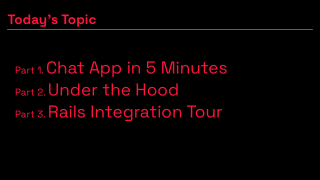
Today’s Topic
Chat App in 5 Minutes
Part 2. Under the Hood
Part 3. Rails Integration Tour
Part 1.
Page: 4
Part 1
Chat App in 5 Minutes
Page: 5
Demo : Chat App
👀 Terminal + two browser windows
Page: 6
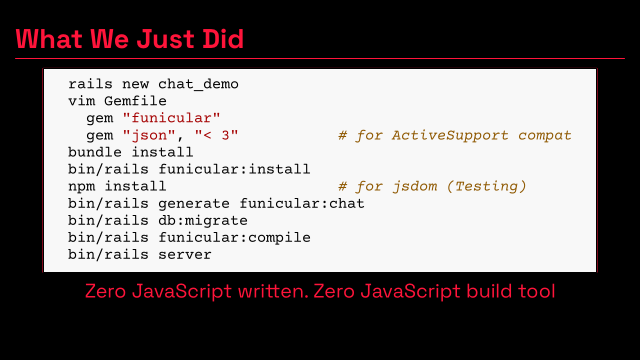
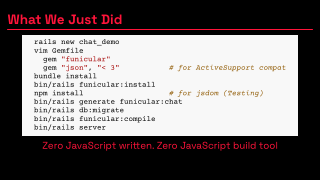
What We Just Did
rails new chat_demo
vim Gemfile
gem "funicular"
gem "json", "< 3"
# for ActiveSupport compat
bundle install
bin/rails funicular:install
npm install
# for jsdom (Testing)
bin/rails generate funicular:chat
bin/rails db:migrate
bin/rails funicular:compile
bin/rails server
Zero JavaScript written. Zero JavaScript build tool
Page: 7
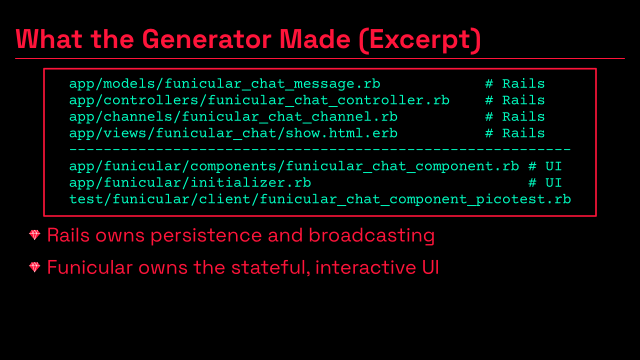
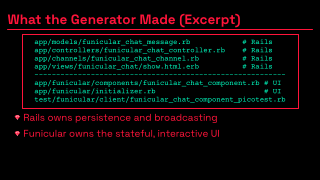
What the Generator Made (Excerpt)
app/models/funicular_chat_message.rb
# Rails
app/controllers/funicular_chat_controller.rb
# Rails
app/channels/funicular_chat_channel.rb
# Rails
app/views/funicular_chat/show.html.erb
# Rails
----------------------------------------------------------
app/funicular/components/funicular_chat_component.rb # UI
app/funicular/initializer.rb
# UI
test/funicular/client/funicular_chat_component_picotest.rb
Rails owns persistence and broadcasting
Funicular owns the stateful, interactive UI
Page: 8
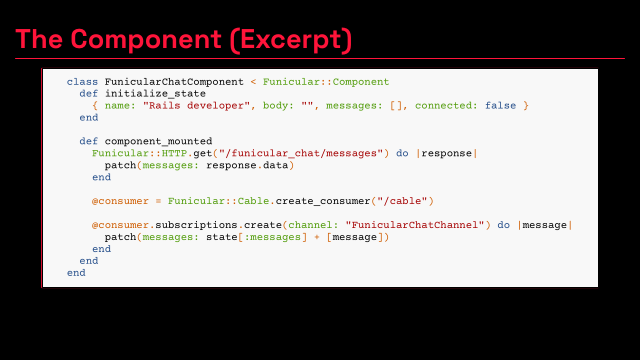
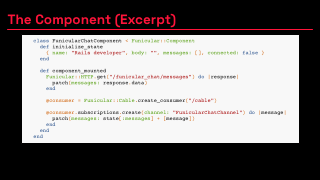
The Component (Excerpt)
class FunicularChatComponent < Funicular::Component
def initialize_state
{ name: "Rails developer", body: "", messages: [], connected: false }
end
def component_mounted
Funicular::HTTP.get("/funicular_chat/messages") do |response|
patch(messages: response.data)
end
@consumer = Funicular::Cable.create_consumer("/cable")
@consumer.subscriptions.create(channel: "FunicularChatChannel") do |message|
patch(messages: state[:messages] + [message])
end
end
end
Page: 9
Wait, Ruby in the browser?
Page: 10
Part 2
Under the Hood
Page: 11
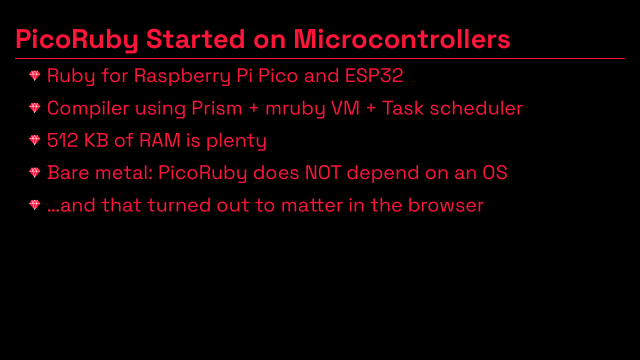
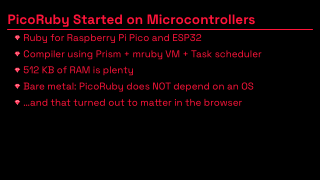
PicoRuby Started on Microcontrollers
Ruby for Raspberry Pi Pico and ESP32
Compiler using Prism + mruby VM + Task scheduler
512 KB of RAM is plenty
Bare metal: PicoRuby does NOT depend on an OS
…and that turned out to matter in the browser
Page: 12
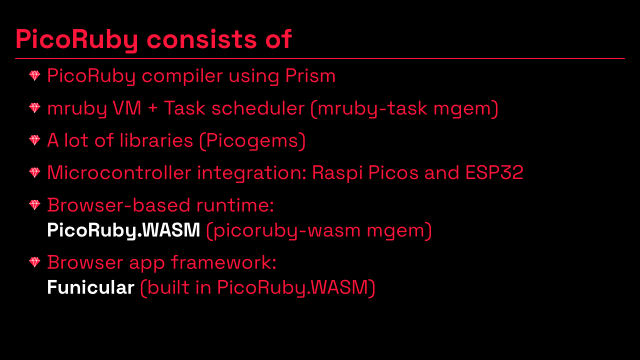
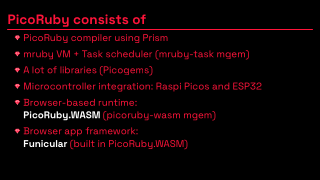
PicoRuby consists of
PicoRuby compiler using Prism
mruby VM + Task scheduler (mruby-task mgem)
A lot of libraries (Picogems)
Microcontroller integration: Raspi Picos and ESP32
Browser-based runtime:
PicoRuby.WASM (picoruby-wasm mgem)
Browser app framework:
Funicular (built in PicoRuby.WASM)
Page: 13
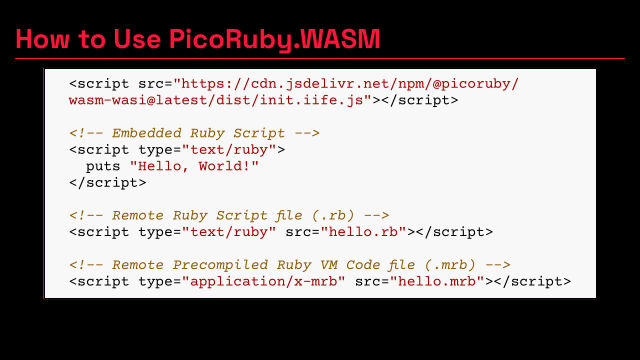
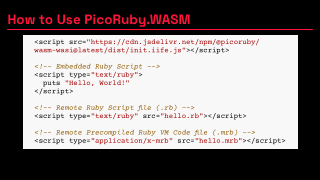
How to Use PicoRuby.WASM
<script src="https://cdn.jsdelivr.net/npm/@picoruby/
wasm-wasi@latest/dist/init.iife.js"></script>
<!-- Embedded Ruby Script -->
<script type="text/ruby">
puts "Hello, World!"
</script>
<!-- Remote Ruby Script file (.rb) -->
<script type="text/ruby" src="hello.rb"></script>
<!-- Remote Precompiled Ruby VM Code file (.mrb) -->
<script type="application/x-mrb" src="hello.mrb"></script>
Page: 14
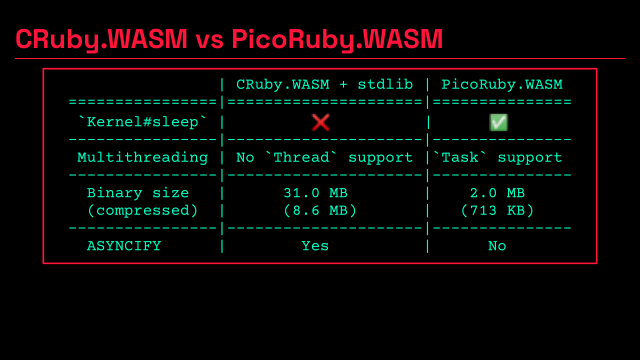
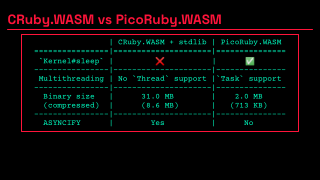
CRuby.WASM vs PicoRuby.WASM
| CRuby.WASM + stdlib | PicoRuby.WASM
================|=====================|===============
`Kernel#sleep` |
|
----------------|---------------------|---------------
Multithreading | No `Thread` support |`Task` support
----------------|---------------------|---------------
Binary size
|
31.0 MB
|
2.0 MB
(compressed) |
(8.6 MB)
|
(713 KB)
----------------|---------------------|---------------
ASYNCIFY
|
Yes
|
No
❌
✅
Page: 15
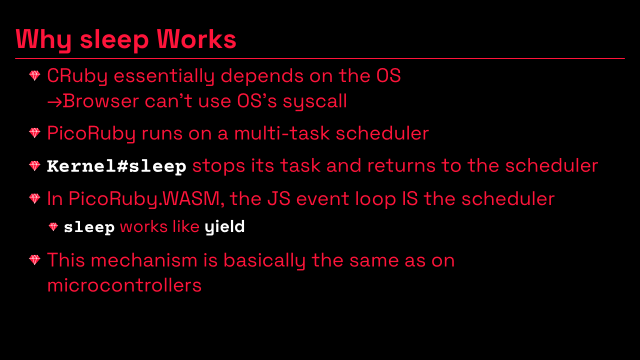
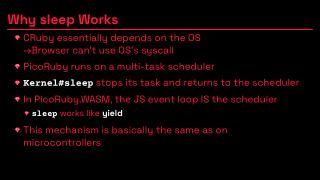
Why sleep Works
CRuby essentially depends on the OS
→Browser can’t use OS’s syscall
PicoRuby runs on a multi-task scheduler
Kernel#sleep stops its task and returns to the scheduler
In PicoRuby.WASM, the JS event loop IS the scheduler
sleep works like yield
This mechanism is basically the same as on
microcontrollers
Page: 16
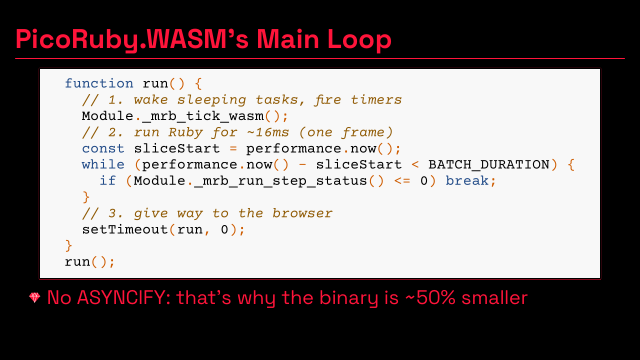
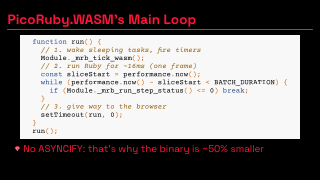
PicoRuby.WASM’s Main Loop
function run() {
// 1. wake sleeping tasks, fire timers
Module._mrb_tick_wasm();
// 2. run Ruby for ~16ms (one frame)
const sliceStart = performance.now();
while (performance.now() - sliceStart < BATCH_DURATION) {
if (Module._mrb_run_step_status() <= 0) break;
}
// 3. give way to the browser
setTimeout(run, 0);
}
run();
No ASYNCIFY: that’s why the binary is ~50% smaller
Page: 17
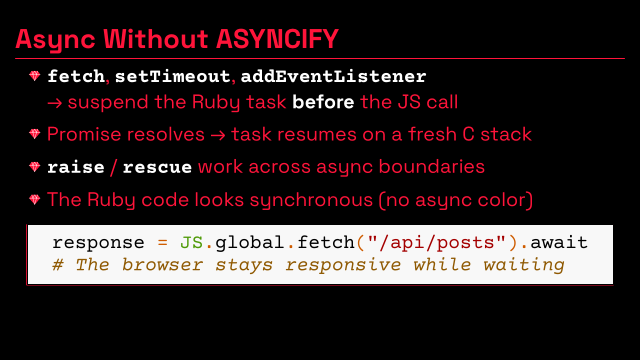
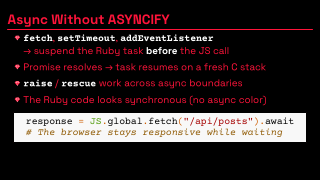
Async Without ASYNCIFY
fetch, setTimeout, addEventListener
→ suspend the Ruby task before the JS call
Promise resolves → task resumes on a fresh C stack
raise / rescue work across async boundaries
The Ruby code looks synchronous (no async color)
response = JS.global.fetch("/api/posts").await
# The browser stays responsive while waiting
Page: 18
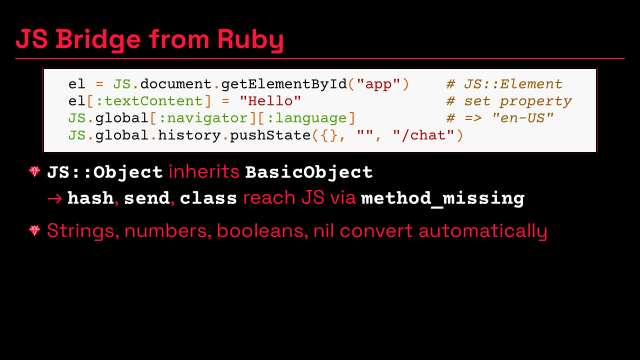
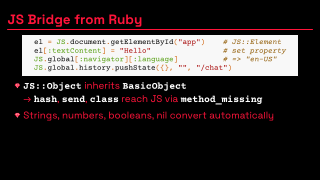
JS Bridge from Ruby
el = JS.document.getElementById("app")
# JS::Element
el[:textContent] = "Hello"
# set property
JS.global[:navigator][:language]
# => "en-US"
JS.global.history.pushState({}, "", "/chat")
JS::Object inherits BasicObject
→ hash, send, class reach JS via method_missing
Strings, numbers, booleans, nil convert automatically
Page: 19
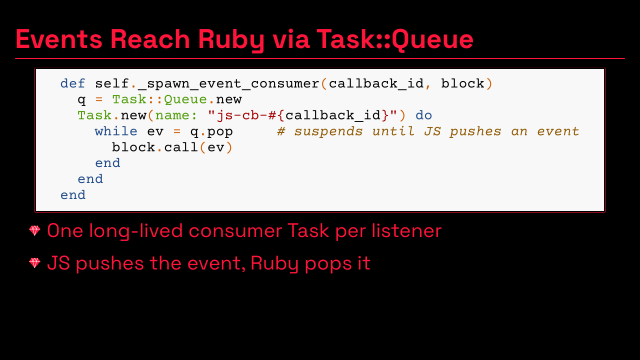
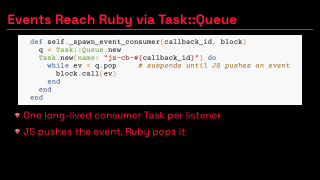
Events Reach Ruby via Task::Queue
def self._spawn_event_consumer(callback_id, block)
q = Task::Queue.new
Task.new(name: "js-cb-#{callback_id}") do
while ev = q.pop
# suspends until JS pushes an event
block.call(ev)
end
end
end
One long-lived consumer Task per listener
JS pushes the event, Ruby pops it
Page: 20
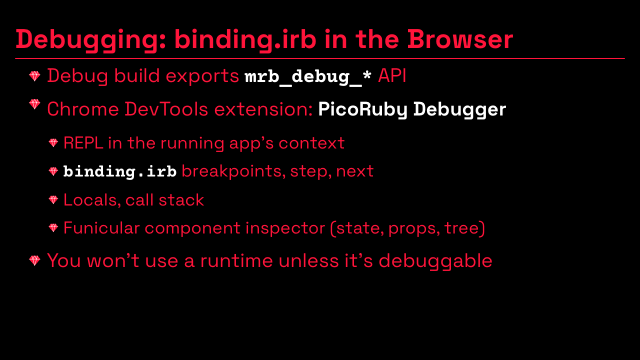
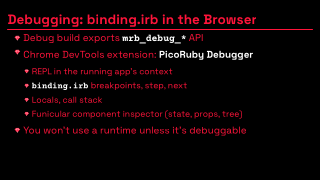
Debugging: binding.irb in the Browser
Debug build exports mrb_debug_* API
Chrome DevTools extension: PicoRuby Debugger
REPL in the running app’s context
binding.irb breakpoints, step, next
Locals, call stack
Funicular component inspector (state, props, tree)
You won’t use a runtime unless it’s debuggable
Page: 21
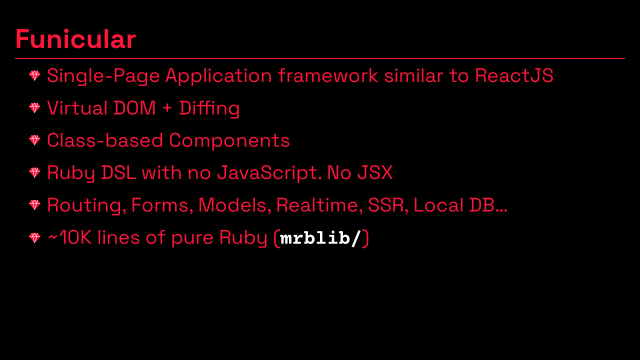
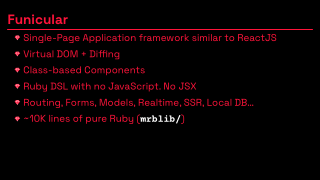
Funicular
Single-Page Application framework similar to ReactJS
Virtual DOM + Diffing
Class-based Components
Ruby DSL with no JavaScript. No JSX
Routing, Forms, Models, Realtime, SSR, Local DB…
~10K lines of pure Ruby (mrblib/)
Page: 22
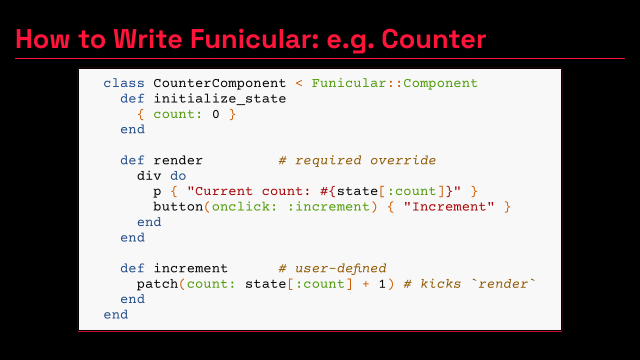
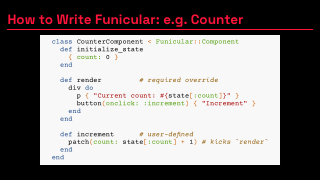
How to Write Funicular: e.g. Counter
class CounterComponent < Funicular::Component
def initialize_state
{ count: 0 }
end
def render
# required override
div do
p { "Current count: #{state[:count]}" }
button(onclick: :increment) { "Increment" }
end
end
def increment
# user-defined
patch(count: state[:count] + 1) # kicks `render`
end
end
Page: 23
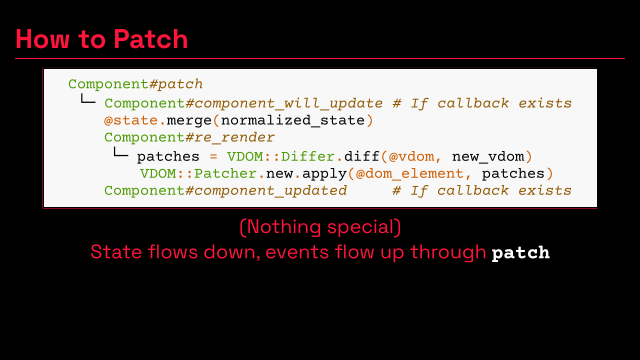
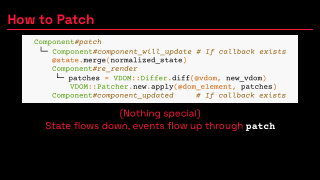
How to Patch
Component#patch
└─ Component#component_will_update # If callback exists
@state.merge(normalized_state)
Component#re_render
└─ patches = VDOM::Differ.diff(@vdom, new_vdom)
VDOM::Patcher.new.apply(@dom_element, patches)
Component#component_updated
# If callback exists
(Nothing special)
State flows down, events flow up through patch
Page: 24
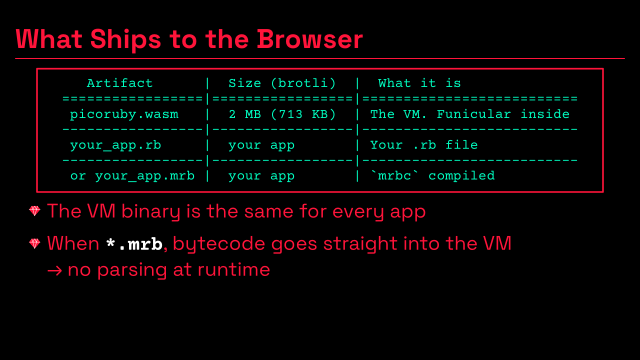
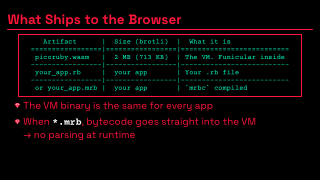
What Ships to the Browser
Artifact
| Size (brotli) | What it is
=================|=================|==========================
picoruby.wasm
| 2 MB (713 KB) | The VM. Funicular inside
-----------------|-----------------|--------------------------
your_app.rb
| your app
| Your .rb file
-----------------|-----------------|--------------------------
or your_app.mrb | your app
| `mrbc` compiled
The VM binary is the same for every app
When *.mrb, bytecode goes straight into the VM
→ no parsing at runtime
Page: 25
Part 3
Rails Integration Tour
Page: 26
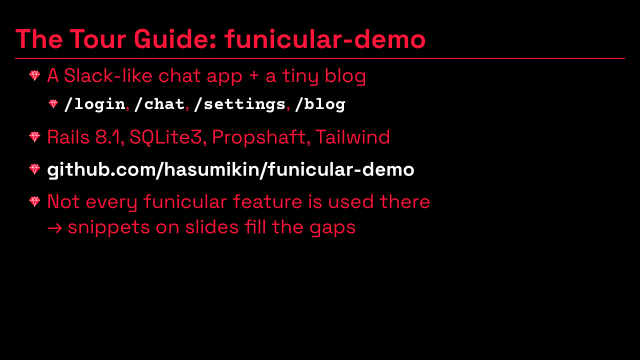
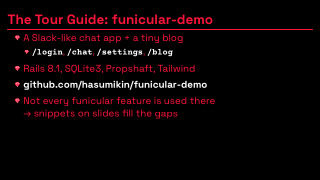
The Tour Guide: funicular-demo
A Slack-like chat app + a tiny blog
/login, /chat, /settings, /blog
Rails 8.1, SQLite3, Propshaft, Tailwind
github.com/hasumikin/funicular-demo
Not every funicular feature is used there
→ snippets on slides fill the gaps
Page: 27
Demo : funicular-demo
👀 Browser: /login → /chat
Page: 28
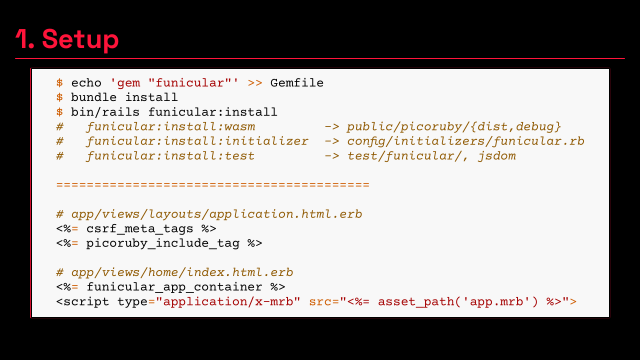
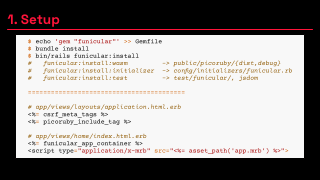
1. Setup
$ echo 'gem "funicular"' >> Gemfile
$ bundle install
$ bin/rails funicular:install
#
funicular:install:wasm
-> public/picoruby/{dist,debug}
#
funicular:install:initializer -> config/initializers/funicular.rb
#
funicular:install:test
-> test/funicular/, jsdom
=========================================
# app/views/layouts/application.html.erb
<%= csrf_meta_tags %>
<%= picoruby_include_tag %>
# app/views/home/index.html.erb
<%= funicular_app_container %>
<script type="application/x-mrb" src="<%= asset_path('app.mrb') %>">
Page: 29
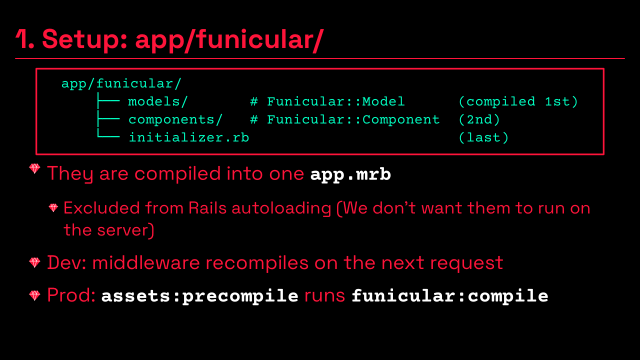
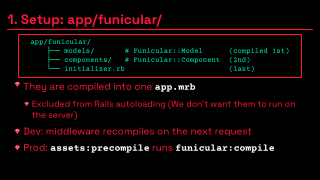
1. Setup: app/funicular/
app/funicular/
├── models/
# Funicular::Model
├── components/
# Funicular::Component
└── initializer.rb
(compiled 1st)
(2nd)
(last)
They are compiled into one app.mrb
Excluded from Rails autoloading (We don’t want them to run on
the server)
Dev: middleware recompiles on the next request
Prod: assets:precompile runs funicular:compile
Page: 30
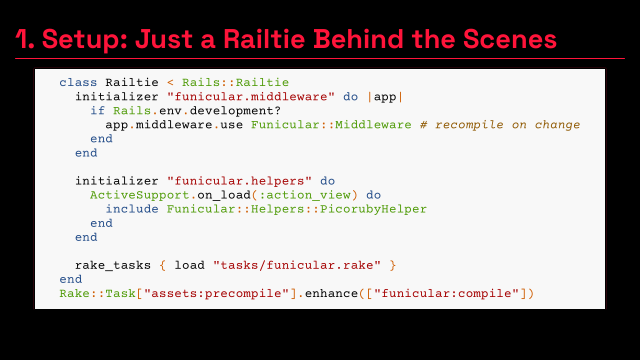
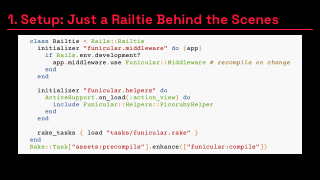
1. Setup: Just a Railtie Behind the Scenes
class Railtie < Rails::Railtie
initializer "funicular.middleware" do |app|
if Rails.env.development?
app.middleware.use Funicular::Middleware # recompile on change
end
end
initializer "funicular.helpers" do
ActiveSupport.on_load(:action_view) do
include Funicular::Helpers::PicorubyHelper
end
end
rake_tasks { load "tasks/funicular.rake" }
end
Rake::Task["assets:precompile"].enhance(["funicular:compile"])
Page: 31
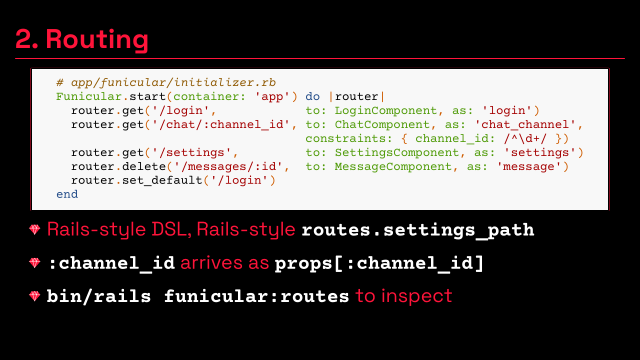
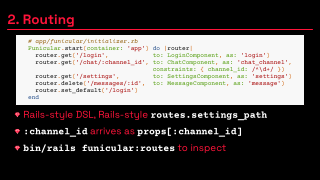
2. Routing
# app/funicular/initializer.rb
Funicular.start(container: 'app') do |router|
router.get('/login',
to: LoginComponent, as: 'login')
router.get('/chat/:channel_id', to: ChatComponent, as: 'chat_channel',
constraints: { channel_id: /^\d+/ })
router.get('/settings',
to: SettingsComponent, as: 'settings')
router.delete('/messages/:id', to: MessageComponent, as: 'message')
router.set_default('/login')
end
Rails-style DSL, Rails-style routes.settings_path
:channel_id arrives as props[:channel_id]
bin/rails funicular:routes to inspect
Page: 32
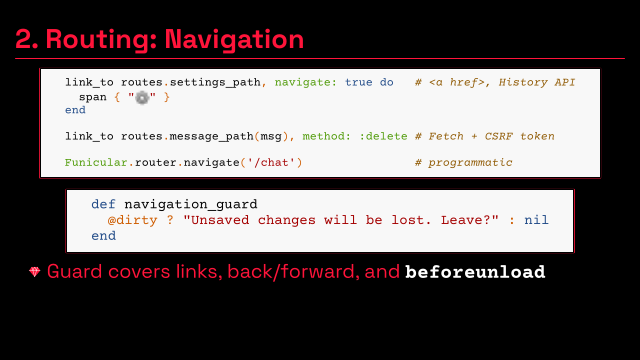
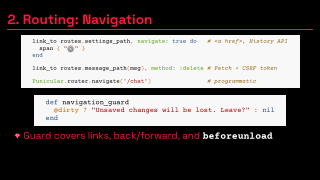
2. Routing: Navigation
⚙️
link_to routes.settings_path, navigate: true do
span { " " }
end
# <a href>, History API
link_to routes.message_path(msg), method: :delete # Fetch + CSRF token
Funicular.router.navigate('/chat')
# programmatic
def navigation_guard
@dirty ? "Unsaved changes will be lost. Leave?" : nil
end
Guard covers links, back/forward, and beforeunload
Page: 33
Demo : Routing
👀 Browser: /chat → channel switch → ⚙️ → back
Page: 34
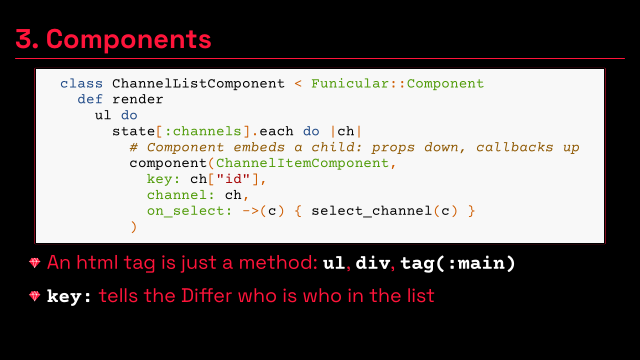
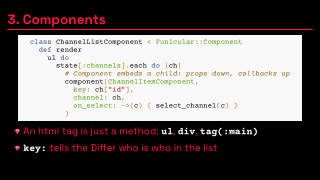
3. Components
class ChannelListComponent < Funicular::Component
def render
ul do
state[:channels].each do |ch|
# Component embeds a child: props down, callbacks up
component(ChannelItemComponent,
key: ch["id"],
channel: ch,
on_select: ->(c) { select_channel(c) }
)
An html tag is just a method: ul, div, tag(:main)
key: tells the Differ who is who in the list
Page: 35
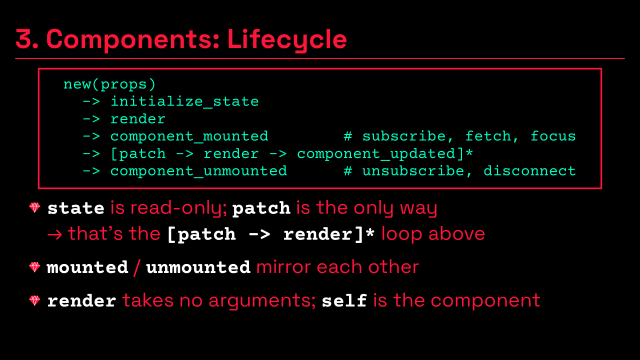
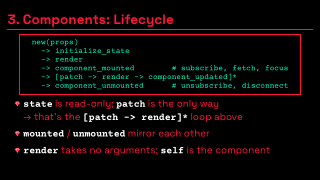
3. Components: Lifecycle
new(props)
-> initialize_state
-> render
-> component_mounted
# subscribe, fetch, focus
-> [patch -> render -> component_updated]*
-> component_unmounted
# unsubscribe, disconnect
state is read-only; patch is the only way
→ that’s the [patch -> render]* loop above
mounted / unmounted mirror each other
render takes no arguments; self is the component
Page: 36
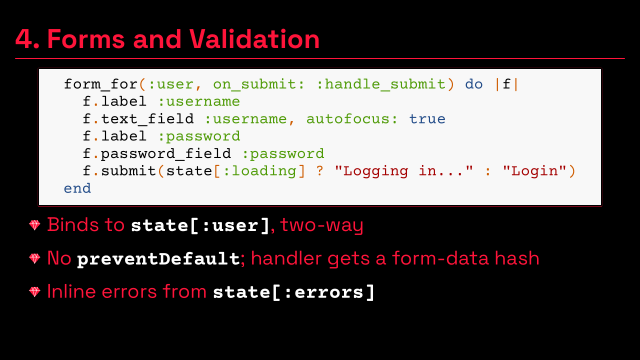
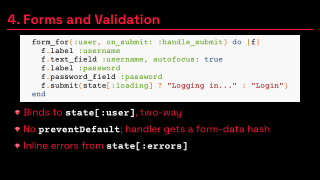
4. Forms and Validation
form_for(:user, on_submit: :handle_submit) do |f|
f.label :username
f.text_field :username, autofocus: true
f.label :password
f.password_field :password
f.submit(state[:loading] ? "Logging in..." : "Login")
end
Binds to state[:user], two-way
No preventDefault; handler gets a form-data hash
Inline errors from state[:errors]
Page: 37
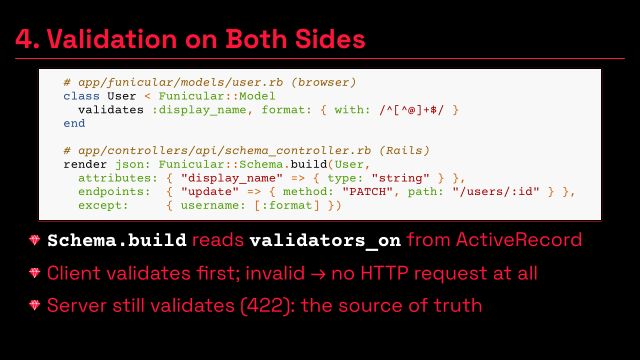
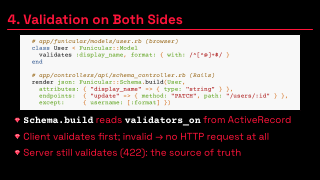
4. Validation on Both Sides
# app/funicular/models/user.rb (browser)
class User < Funicular::Model
validates :display_name, format: { with: /^[^@]+$/ }
end
# app/controllers/api/schema_controller.rb (Rails)
render json: Funicular::Schema.build(User,
attributes: { "display_name" => { type: "string" } },
endpoints: { "update" => { method: "PATCH", path: "/users/:id" } },
except:
{ username: [:format] })
Schema.build reads validators_on from ActiveRecord
Client validates first; invalid → no HTTP request at all
Server still validates (422): the source of truth
Page: 38
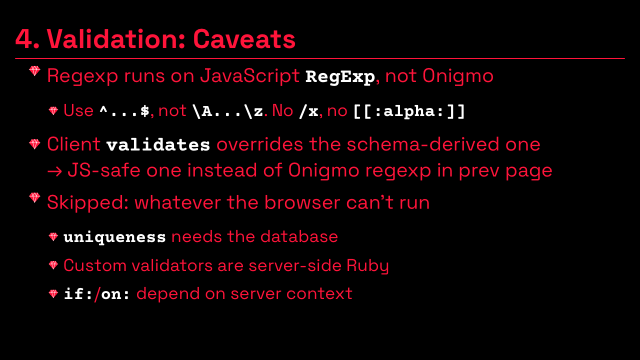
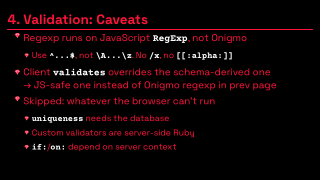
4. Validation: Caveats
Regexp runs on JavaScript RegExp, not Onigmo
Use ^...$, not \A...\z. No /x, no [[:alpha:]]
Client validates overrides the schema-derived one
→ JS-safe one instead of Onigmo regexp in prev page
Skipped: whatever the browser can’t run
uniqueness needs the database
Custom validators are server-side Ruby
if:/on: depend on server context
Page: 39
Demo : Forms
👀 Browser: /settings → type “@” in display name
Page: 40
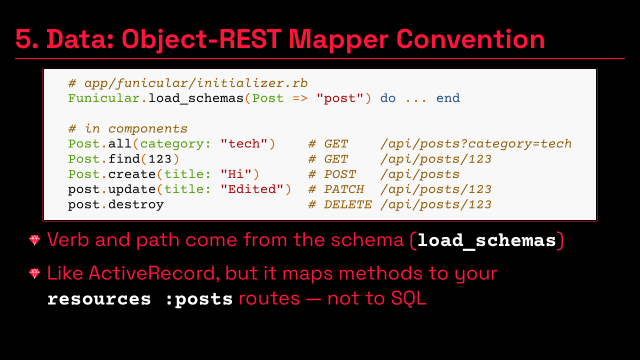
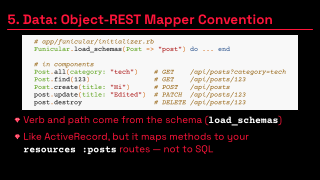
5. Data: Object-REST Mapper Convention
# app/funicular/initializer.rb
Funicular.load_schemas(Post => "post") do ... end
# in components
Post.all(category: "tech")
Post.find(123)
Post.create(title: "Hi")
post.update(title: "Edited")
post.destroy
# GET
/api/posts?category=tech
# GET
/api/posts/123
# POST
/api/posts
# PATCH /api/posts/123
# DELETE /api/posts/123
Verb and path come from the schema (load_schemas)
Like ActiveRecord, but it maps methods to your
resources :posts routes — not to SQL
Page: 41
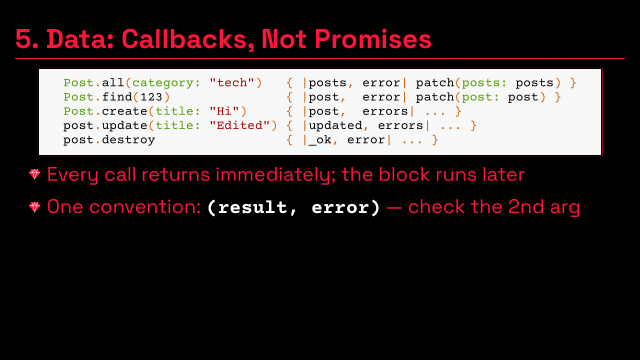
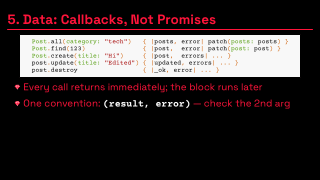
5. Data: Callbacks, Not Promises
Post.all(category: "tech")
{ |posts, error| patch(posts: posts) }
Post.find(123)
{ |post, error| patch(post: post) }
Post.create(title: "Hi")
{ |post, errors| ... }
post.update(title: "Edited") { |updated, errors| ... }
post.destroy
{ |_ok, error| ... }
Every call returns immediately; the block runs later
One convention: (result, error) — check the 2nd arg
Page: 42
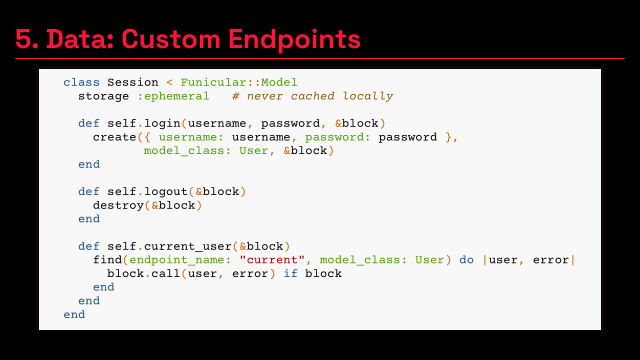
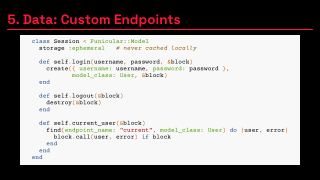
5. Data: Custom Endpoints
class Session < Funicular::Model
storage :ephemeral
# never cached locally
def self.login(username, password, &block)
create({ username: username, password: password },
model_class: User, &block)
end
def self.logout(&block)
destroy(&block)
end
def self.current_user(&block)
find(endpoint_name: "current", model_class: User) do |user, error|
block.call(user, error) if block
end
end
end
Page: 43
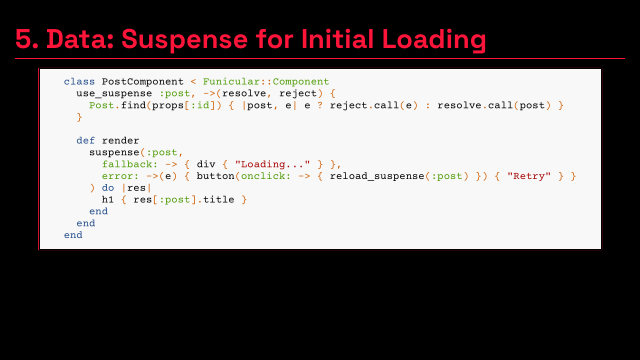
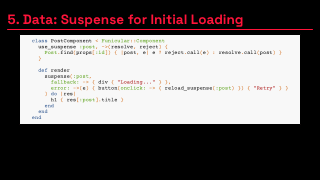
5. Data: Suspense for Initial Loading
class PostComponent < Funicular::Component
use_suspense :post, ->(resolve, reject) {
Post.find(props[:id]) { |post, e| e ? reject.call(e) : resolve.call(post) }
}
def render
suspense(:post,
fallback: -> { div { "Loading..." } },
error: ->(e) { button(onclick: -> { reload_suspense(:post) }) { "Retry" } }
) do |res|
h1 { res[:post].title }
end
end
end
Page: 44
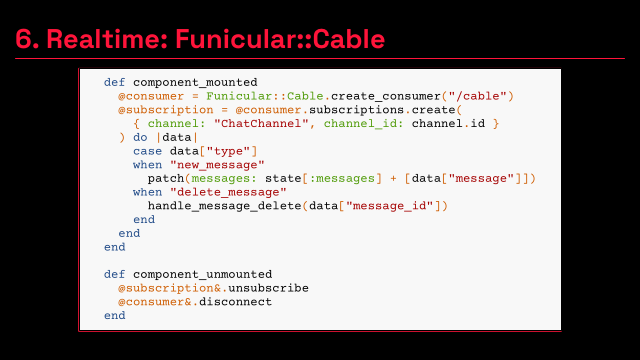
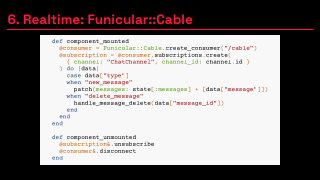
6. Realtime: Funicular::Cable
def component_mounted
@consumer = Funicular::Cable.create_consumer("/cable")
@subscription = @consumer.subscriptions.create(
{ channel: "ChatChannel", channel_id: channel.id }
) do |data|
case data["type"]
when "new_message"
patch(messages: state[:messages] + [data["message"]])
when "delete_message"
handle_message_delete(data["message_id"])
end
end
end
def component_unmounted
@subscription&.unsubscribe
@consumer&.disconnect
end
Page: 45
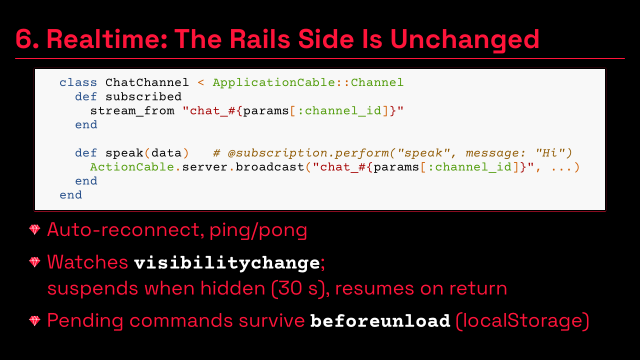
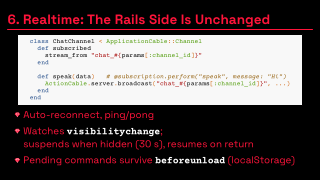
6. Realtime: The Rails Side Is Unchanged
class ChatChannel < ApplicationCable::Channel
def subscribed
stream_from "chat_#{params[:channel_id]}"
end
def speak(data)
# @subscription.perform("speak", message: "Hi")
ActionCable.server.broadcast("chat_#{params[:channel_id]}", ...)
end
end
Auto-reconnect, ping/pong
Watches visibilitychange;
suspends when hidden (30 s), resumes on return
Pending commands survive beforeunload (localStorage)
Page: 46
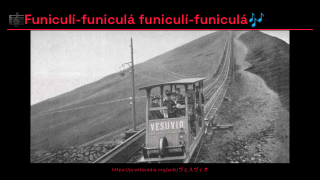
🎼
🎶
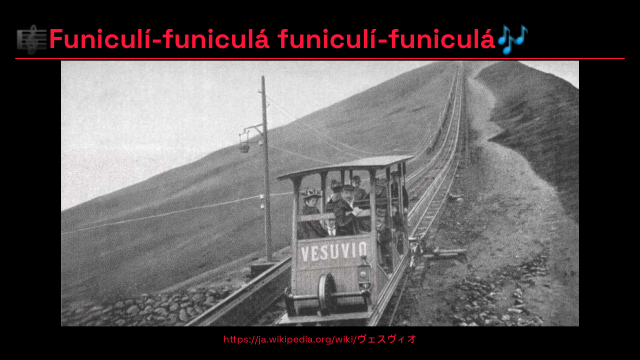
Funiculí-funiculá funiculí-funiculá
https://ja.wikipedia.org/wiki/ヴェスヴィオ
Page: 47
Demo : Realtime
👀 Browser: two windows on /chat, delete a message
Page: 48
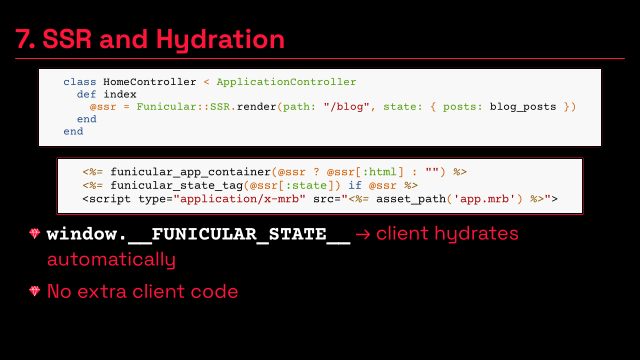
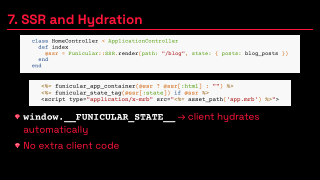
7. SSR and Hydration
class HomeController < ApplicationController
def index
@ssr = Funicular::SSR.render(path: "/blog", state: { posts: blog_posts })
end
end
<%= funicular_app_container(@ssr ? @ssr[:html] : "") %>
<%= funicular_state_tag(@ssr[:state]) if @ssr %>
<script type="application/x-mrb" src="<%= asset_path('app.mrb') %>">
window.__FUNICULAR_STATE__ → client hydrates
automatically
No extra client code
Page: 49
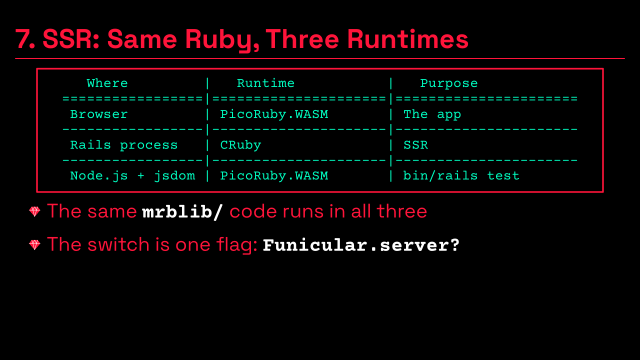
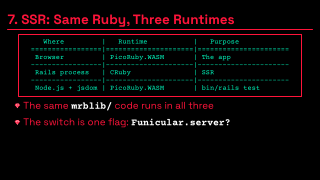
7. SSR: Same Ruby, Three Runtimes
Where
|
Runtime
|
Purpose
=================|=====================|======================
Browser
| PicoRuby.WASM
| The app
-----------------|---------------------|----------------------
Rails process
| CRuby
| SSR
-----------------|---------------------|----------------------
Node.js + jsdom | PicoRuby.WASM
| bin/rails test
The same mrblib/ code runs in all three
The switch is one flag: Funicular.server?
Page: 50
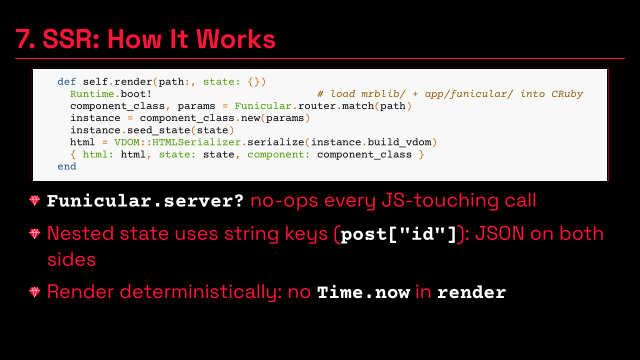
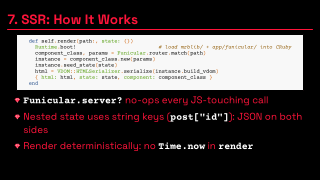
7. SSR: How It Works
def self.render(path:, state: {})
Runtime.boot!
# load mrblib/ + app/funicular/ into CRuby
component_class, params = Funicular.router.match(path)
instance = component_class.new(params)
instance.seed_state(state)
html = VDOM::HTMLSerializer.serialize(instance.build_vdom)
{ html: html, state: state, component: component_class }
end
Funicular.server? no-ops every JS-touching call
Nested state uses string keys (post["id"]): JSON on both
sides
Render deterministically: no Time.now in render
Page: 51
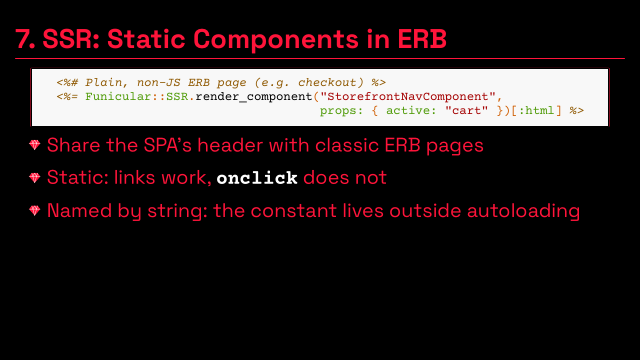
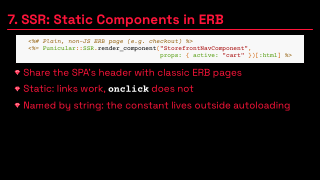
7. SSR: Static Components in ERB
<%# Plain, non-JS ERB page (e.g. checkout) %>
<%= Funicular::SSR.render_component("StorefrontNavComponent",
props: { active: "cart" })[:html] %>
Share the SPA’s header with classic ERB pages
Static: links work, onclick does not
Named by string: the constant lives outside autoloading
Page: 52
Demo : SSR
👀 Browser: /blog → view-source → /blog/1
Page: 53
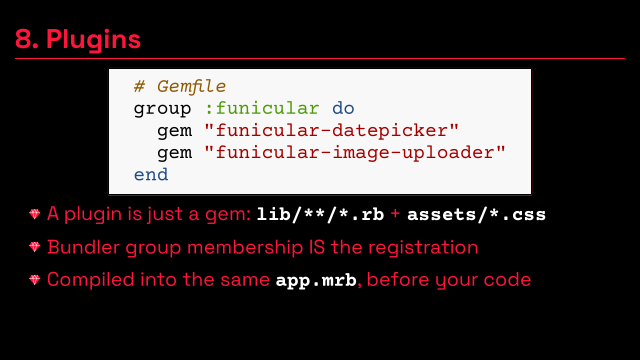
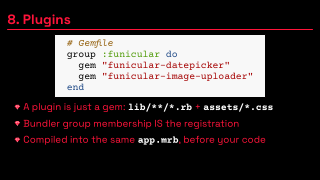
8. Plugins
# Gemfile
group :funicular do
gem "funicular-datepicker"
gem "funicular-image-uploader"
end
A plugin is just a gem: lib/**/*.rb + assets/*.css
Bundler group membership IS the registration
Compiled into the same app.mrb, before your code
Page: 54
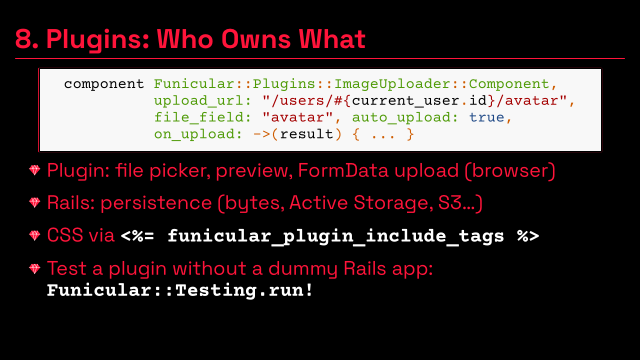
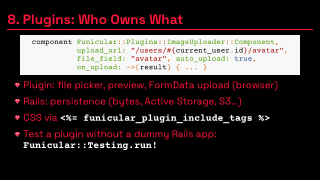
8. Plugins: Who Owns What
component Funicular::Plugins::ImageUploader::Component,
upload_url: "/users/#{current_user.id}/avatar",
file_field: "avatar", auto_upload: true,
on_upload: ->(result) { ... }
Plugin: file picker, preview, FormData upload (browser)
Rails: persistence (bytes, Active Storage, S3…)
CSS via <%= funicular_plugin_include_tags %>
Test a plugin without a dummy Rails app:
Funicular::Testing.run!
Page: 55
Demo : Plugins
👀 Browser: /settings → date picker, avatar upload
Page: 56
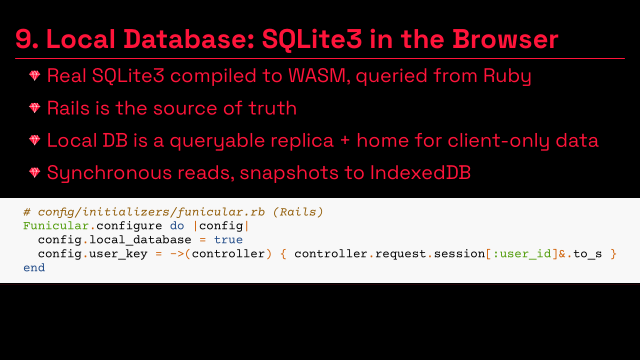
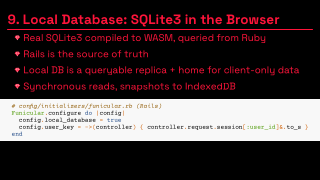
9. Local Database: SQLite3 in the Browser
Real SQLite3 compiled to WASM, queried from Ruby
Rails is the source of truth
Local DB is a queryable replica + home for client-only data
Synchronous reads, snapshots to IndexedDB
# config/initializers/funicular.rb (Rails)
Funicular.configure do |config|
config.local_database = true
config.user_key = ->(controller) { controller.request.session[:user_id]&.to_s }
end
Page: 57
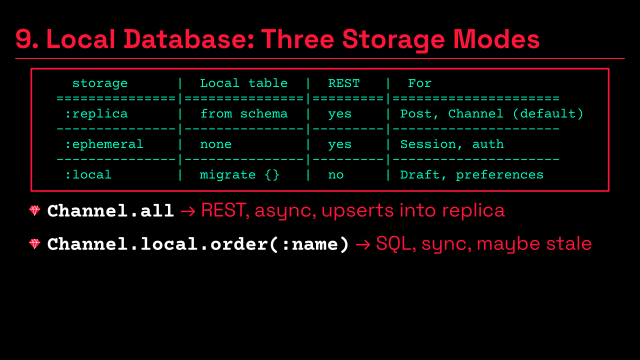
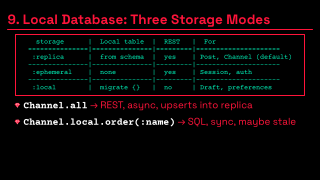
9. Local Database: Three Storage Modes
storage
| Local table | REST
| For
===============|===============|=========|=====================
:replica
| from schema | yes
| Post, Channel (default)
---------------|---------------|---------|---------------------
:ephemeral
| none
| yes
| Session, auth
---------------|---------------|---------|---------------------
:local
| migrate {}
| no
| Draft, preferences
Channel.all → REST, async, upserts into replica
Channel.local.order(:name) → SQL, sync, maybe stale
Page: 58
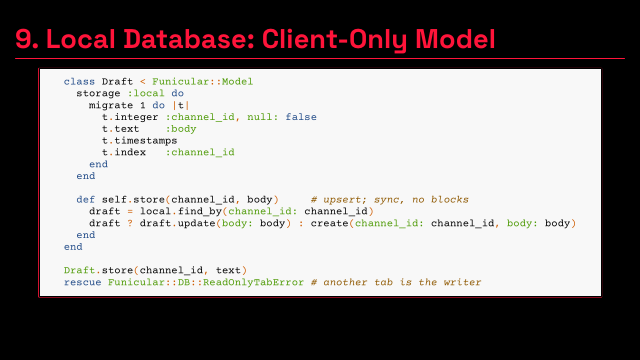
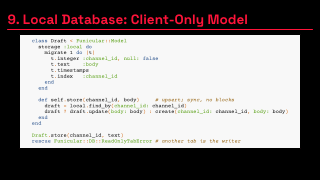
9. Local Database: Client-Only Model
class Draft < Funicular::Model
storage :local do
migrate 1 do |t|
t.integer :channel_id, null: false
t.text
:body
t.timestamps
t.index
:channel_id
end
end
def self.store(channel_id, body)
# upsert; sync, no blocks
draft = local.find_by(channel_id: channel_id)
draft ? draft.update(body: body) : create(channel_id: channel_id, body: body)
end
end
Draft.store(channel_id, text)
rescue Funicular::DB::ReadOnlyTabError # another tab is the writer
Page: 59
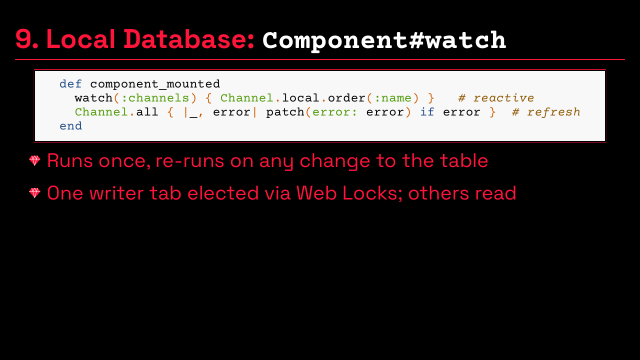
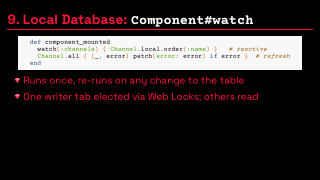
9. Local Database: Component#watch
def component_mounted
watch(:channels) { Channel.local.order(:name) }
# reactive
Channel.all { |_, error| patch(error: error) if error } # refresh
end
Runs once, re-runs on any change to the table
One writer tab elected via Web Locks; others read
Page: 60
Demo : Local DB
👀 Browser: type a draft, switch channel, reload, DevTools >
IndexedDB
Page: 61
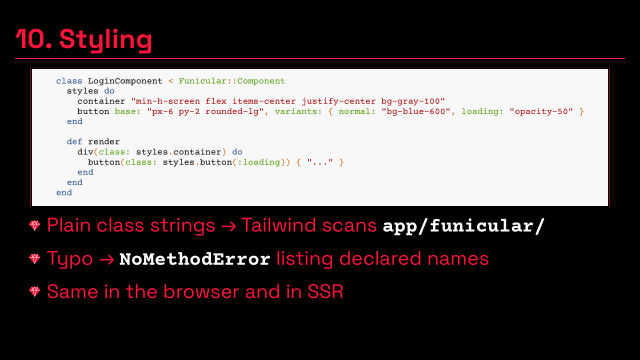
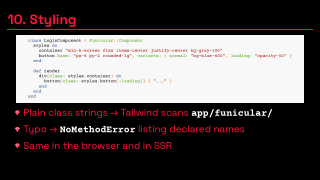
10. Styling
class LoginComponent < Funicular::Component
styles do
container "min-h-screen flex items-center justify-center bg-gray-100"
button base: "px-6 py-2 rounded-lg", variants: { normal: "bg-blue-600", loading: "opacity-50" }
end
def render
div(class: styles.container) do
button(class: styles.button(:loading)) { "..." }
end
end
end
Plain class strings → Tailwind scans app/funicular/
Typo → NoMethodError listing declared names
Same in the browser and in SSR
Page: 62
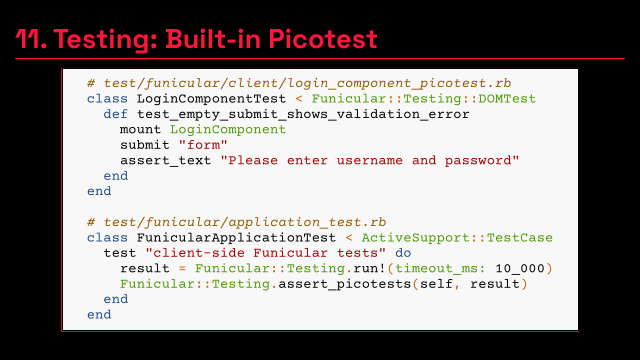
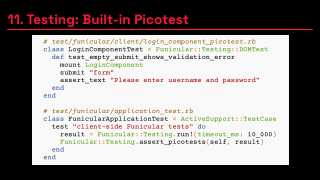
11. Testing: Built-in Picotest
# test/funicular/client/login_component_picotest.rb
class LoginComponentTest < Funicular::Testing::DOMTest
def test_empty_submit_shows_validation_error
mount LoginComponent
submit "form"
assert_text "Please enter username and password"
end
end
# test/funicular/application_test.rb
class FunicularApplicationTest < ActiveSupport::TestCase
test "client-side Funicular tests" do
result = Funicular::Testing.run!(timeout_ms: 10_000)
Funicular::Testing.assert_picotests(self, result)
end
end
Page: 63
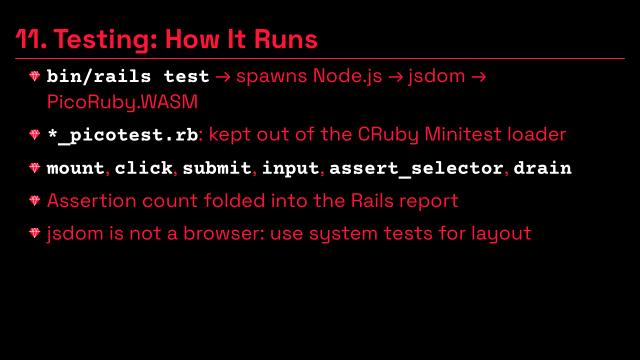
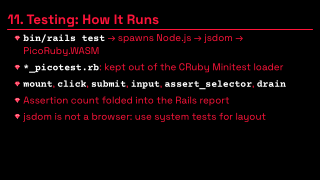
11. Testing: How It Runs
bin/rails test → spawns Node.js → jsdom →
PicoRuby.WASM
*_picotest.rb: kept out of the CRuby Minitest loader
mount, click, submit, input, assert_selector, drain
Assertion count folded into the Rails report
jsdom is not a browser: use system tests for layout
Page: 64
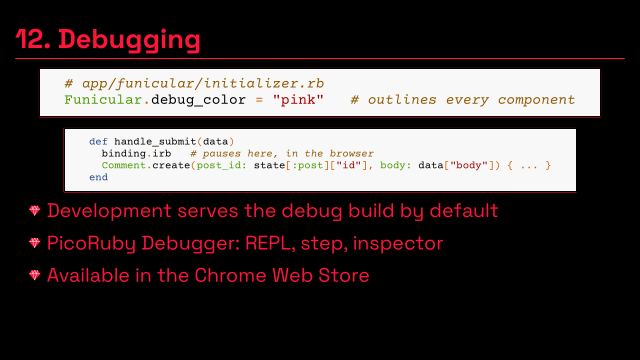
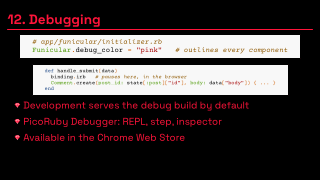
12. Debugging
# app/funicular/initializer.rb
Funicular.debug_color = "pink"
# outlines every component
def handle_submit(data)
binding.irb
# pauses here, in the browser
Comment.create(post_id: state[:post]["id"], body: data["body"]) { ... }
end
Development serves the debug build by default
PicoRuby Debugger: REPL, step, inspector
Available in the Chrome Web Store
Page: 65
Demo : Debugging
👀 Browser: debug_color, DevTools > PicoRuby > component tree
Page: 67
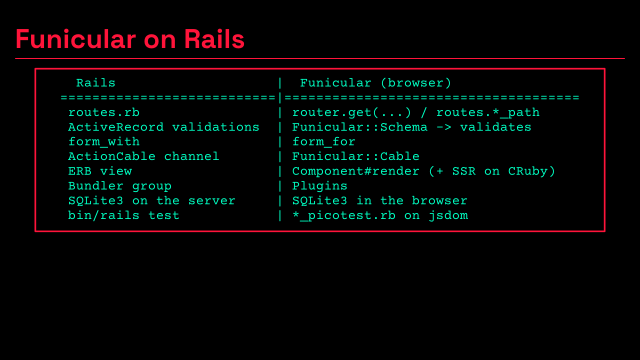
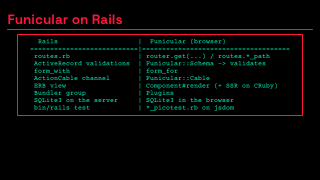
Funicular on Rails
Rails
| Funicular (browser)
===========================|=====================================
routes.rb
| router.get(...) / routes.*_path
ActiveRecord validations | Funicular::Schema -> validates
form_with
| form_for
ActionCable channel
| Funicular::Cable
ERB view
| Component#render (+ SSR on CRuby)
Bundler group
| Plugins
SQLite3 on the server
| SQLite3 in the browser
bin/rails test
| *_picotest.rb on jsdom
Page: 68
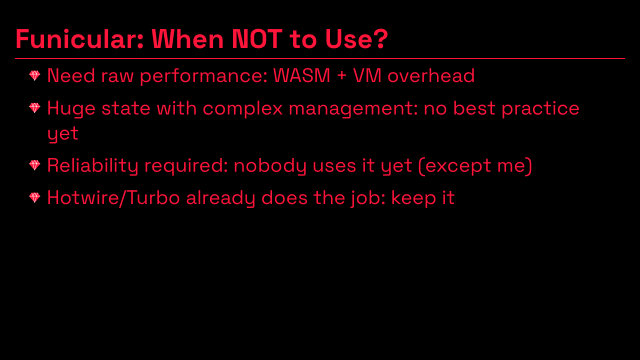
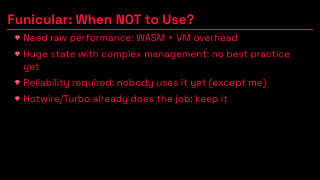
Funicular: When NOT to Use?
Need raw performance: WASM + VM overhead
Huge state with complex management: no best practice
yet
Reliability required: nobody uses it yet (except me)
Hotwire/Turbo already does the job: keep it
Page: 69
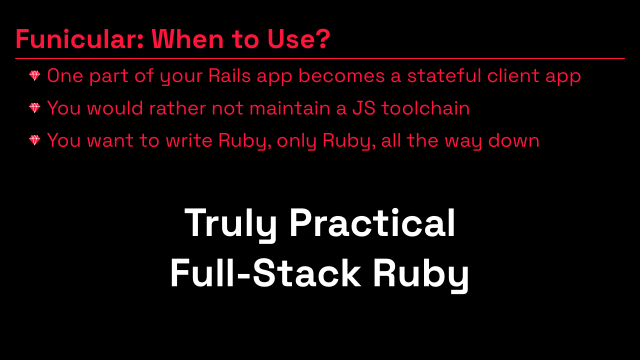
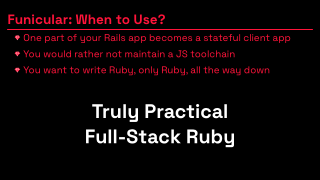
Funicular: When to Use?
One part of your Rails app becomes a stateful client app
You would rather not maintain a JS toolchain
You want to write Ruby, only Ruby, all the way down
Truly Practical
Full-Stack Ruby
Page: 70
🌟
Stargaze at
github.com/picoruby/funicular
👀
Docs and tutorials
picoruby.org/funicular